Bedrock ThrottlingException: add a region, add its quota
TL;DR
Amazon Bedrock quota is per region and per model. If you are seeing ThrottlingException, you are usually not at the limit of what AWS will sell you. You are at the limit of the one region you deployed in. Adding a second region brings that region's own quota with it, and it needs no conversation with your account team.
You are most likely already on a cross-region inference profile, which has a separate quota again, counted in the region you call from. After that, four limits catch people: a stream cannot fail over once it has started, an asynchronous invocation stays in the region that accepted it, more regions is not automatically more throughput, and spreading works against your prompt cache.
It is usually not a capacity problem
ThrottlingException reads like a wall. Most of the time it is a topology detail.
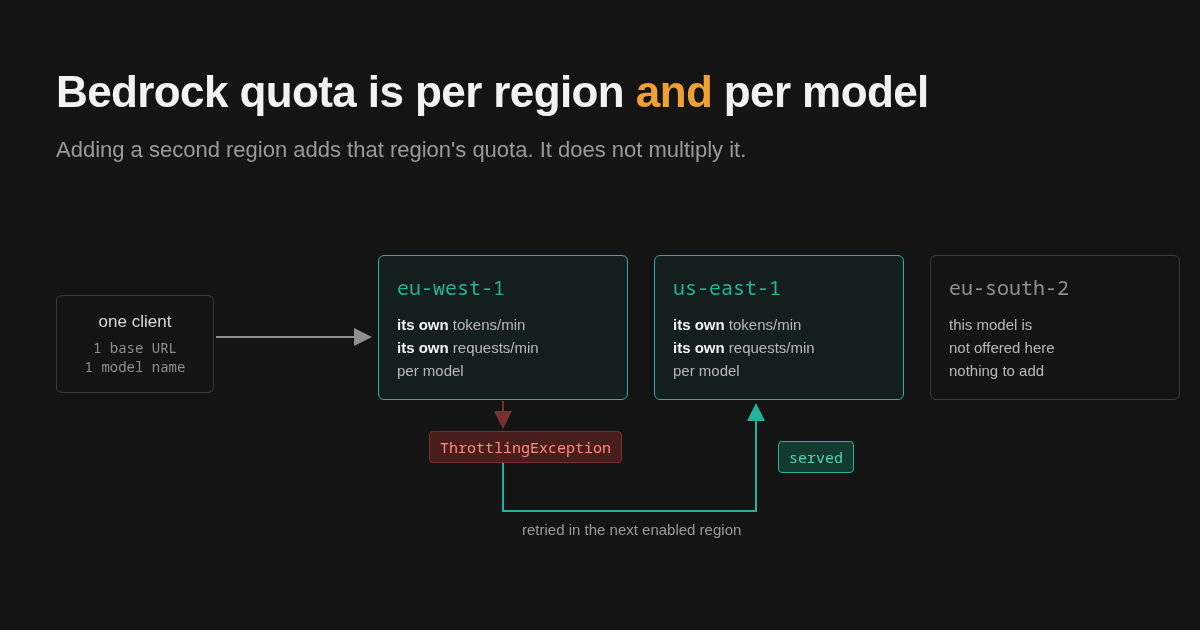
Every AWS region maintains its own independent Bedrock quota. Not a shared pool with regional views of it: separate numbers, tracked separately. Nothing you are granted in eu-west-1 has any effect on us-east-1, and a quota increase approved for one is invisible to the other.
The quota is also per model. anthropic.claude-* and amazon.nova-* in the same region have separate tokens-per-minute quotas, and separate requests-per-minute quotas where the model has one at all, because AWS enforces RPM for some models and not others. Burning through one leaves the other untouched.
Output tokens are also not counted one for one. AWS applies a burndown rate: "the burndown rate for Anthropic Claude models version 4.8 is 15x for output tokens (1 output token consumes 15 tokens from your quotas) and the burndown rate for Anthropic Claude Sonnet 5, Claude Opus 5, and Claude Fable 5.1 is 10x for output tokens". A generation-heavy workload therefore reaches the ceiling far sooner than a token count suggests.
So there are two dimensions, and the practical consequence is that capacity planning which treats "our Bedrock quota" as a single number is planning against a number that does not exist. The thing you actually have is a matrix.
What a second region buys
The matrix is also the lever. Pointing traffic at a second region adds that region's quota to what you can reach, without asking anyone.
It is the cheapest throughput increase available on Bedrock. A quota increase request is a support ticket with a review and a wait. Provisioned throughput is a commitment with a bill attached. Reaching a second region is an IAM policy and a first call: serverless models enable themselves on first invocation given the AWS Marketplace permissions, and the region's default quota is usually available from that call. If it is an opt-in region, the account has to be opted in first.
Check the applied value in Service Quotas before you plan on it, because a new account can carry a reduced one. AWS says the quotas assigned to an account "might be updated depending on regional factors, payment history, fraudulent usage, and/or approval of a quota increase request", so an approved request is one of four triggers rather than the only one. That is not only theory here. On one new account the reduced quota did come up without any increase request being filed, though support had been contacted about it. Whether that was the conversation or simply the account ageing into normal use cannot be separated after the fact, so treat it as a reason to check the number rather than as a mechanism to rely on.
What it is not is a multiplier. Three regions does not mean three times the throughput, for reasons in the section on limits below, and anyone selling it to you that way is rounding off the part that matters.
It does buy something you were not asking for. The same spread that adds quota also means one region having a bad afternoon stops being your outage. Treat that as a side effect rather than as a design: a stream still cannot move mid-response and an asynchronous invocation still does not migrate, so it covers the next request rather than the one that was in flight.
You are probably already on a cross-region inference profile
This is not advice, it is a fact about the current catalogue. For many of the models people actually want there is no in-region on-demand path at all. Of the 135 Bedrock models across 31 regions in the catalogue on 2026-09-08, 110 are served through Bedrock Runtime, and 35 of those are reachable only through an inference profile. That includes the current Claude line. The us., eu. or global. identifier is not an optimisation you opt into. It is the only way in.
That one is checkable in a minute, and worth checking:
$ aws bedrock list-foundation-models --region us-east-1 \
    --query "modelSummaries[?contains(modelId,'claude')].[modelId,inferenceTypesSupported]"
On a test account that returns 16 Claude models, and exactly one carries ON_DEMAND: anthropic.claude-3-haiku-20240307-v1:0, from March 2024. Every other Claude model comes back INFERENCE_PROFILE and nothing else. Run it in your region before you plan around in-region capacity for Claude.
One scoping note, because it changes what the answer means: this call lists models on the Bedrock Runtime endpoint. Models served only through bedrock-mantle do not appear in it at all, so treat the output as the runtime catalogue rather than as everything Bedrock will sell you.
That does not exempt you from quota, and this is the part that surprises people. The profile has its own allowance: Bedrock counts Cross-Region InvokeModel tokens per minute separately from On-demand InvokeModel tokens per minute. A separate bucket, exhausted just as easily, and the ThrottlingException looks identical.
So where does extra quota come from, if you cannot leave the profile? Calling the same profile from a second source region did yield more headroom. You are not adding a destination, you are adding a source.
The evidence for that sentence deserves stating plainly, because it is the most useful line here and the most weakly sourced. It came from testing rather than from documentation, and the test is some months old. AWS scopes the quota per model, per Region in its own tables, and for a caller-side quota that region is the one you call from, so the behaviour is consistent with how the quota is described. But AWS nowhere states that a second source region gives you a second allowance, and no third-party source appears to either. It is one account's measurement against undocumented behaviour, which means AWS is free to change it without telling anybody.
It gets shakier on global profiles, where AWS's own pages disagree with each other: the global cross-region page says "This is a global limit", while the General Reference lists the same quota as "Each supported Region: 10,000". Those cannot both be operative, and the favourable reading is not the safe one.
So: try it on your own account and read the applied values in Service Quotas in each source region. Do not put it in a capacity plan on the strength of this page alone.
Provisioned Throughput is not the fallback. AWS states that "inference profiles currently don't support Provisioned Throughput", so on a profile-only model that lever is closed. What remains is more source regions, an increase request, batch inference, or the Flex tier.
Two properties of profiles still shape the design.
A geography-scoped profile has a fixed destination list. AWS states that a profile tied to a geography such as US or EU will never change the regions it routes to. It is a set you select, not a set you compose, so if your allowed regions do not line up with a published geography, the profile is not expressing your constraint.
A global profile routes worldwide and its list grows as AWS adds regions. If you have a residency position this is the tier that breaks it: permitting it means permitting aws:RequestedRegion to be unspecified in your policies, which is a decision to take deliberately rather than to discover.
If one source region's profile quota covers your traffic, stop here. You do not need anything else.
When a profile is not enough, and why it gets postponed
The remaining case is real: your permitted regions are not a geography, or the model has no profile, or you want to spread across profiles and on-demand capacity at once. That is where the work appears.
You declare the same model once per region. Each entry carries its own tokens-per-minute and requests-per-minute limits, so the config grows as the product of models and regions rather than the sum. LiteLLM's router works exactly this way: each model is declared once per region, and TPM and RPM go on each entry if you want its usage-based routing rather than the default shuffle.
You maintain an availability list that AWS keeps invalidating. Model availability by region changes on AWS's schedule, not yours. Every launch, every regional expansion and every deprecation edits your config, and nothing tells you it has happened except a failure.
You write retry logic in the application, or in a proxy you configure and operate. Doing it in the application is the awkward one, because that layer has the least idea which regions are currently healthy. It knows the call failed. It does not know whether the next region is any better, and by the time it finds out it has spent the user's latency budget discovering it.
The four limits that catch people
1. A stream cannot fail over once it has started. Retry works before the stream opens. Once bytes are flowing the region is locked, and nothing in front of Bedrock changes that. So a mid-stream failure surfaces to the user, and if your product is a chat UI, this is the failure mode you will actually see.
2. An asynchronous invocation stays where it landed. A StartAsyncInvoke job, the API behind video and other long-running generation, selects its region when it starts and nothing in front of Bedrock moves it afterwards. Batch inference is the exception, not the rule: submit it through a cross-region inference profile and AWS spreads the compute across the profile's regions itself, against batch's own separate quota. Only the job record and its S3 input and output stay in the region you submitted from.
3. More regions is not automatically more throughput. This is the one most often skipped in "multi-region for resilience" write-ups. Quota is per region and per model, and the model you want may exist in a handful of regions rather than all of them. Adding a region that does not carry your model adds nothing at all. Check availability first and plan capacity second, not the other way round.
4. Spreading regions works against your prompt cache. AWS says this plainly about cross-region inference: "at times of high demand, these optimizations may lead to increased cache writes." The read is the cheap side of caching and the write can be dearer than an ordinary input token, billed at 1.25× the uncached input rate on the GPT-5.6 family. You cannot pin the routing to protect it either: "You can't choose a specific Region to process your request. If you must process your requests in a specific Region, then use on-demand models directly in that Region." So on a workload with a large shared prefix, spreading can have you re-paying for prompts you had already cached, and the bill moves before the throughput does.
There is a corollary worth acting on before you add anything at all, and it holds on both endpoints. On bedrock-runtime the quota is burned as InputTokenCount + CacheWriteInputTokenCount + (OutputTokenCount x burndown rate), and CacheReadInputTokenCount values "don't contribute to this calculation and are not counted toward your quota". On bedrock-mantle AWS states that "cached input tokens read through prompt caching do not count against the input-tokens-per-minute quota". So a better cache hit rate is itself a throughput lever, and a cheaper one than a second region. It does not extend everywhere: "prompt caching is only supported for on-demand inference endpoints. It is not supported with the batch inference API."
The constraint that comes first
Which regions you are allowed to enable is not a capacity decision. It is usually a data-residency decision, made by someone who has never seen a ThrottlingException and who is not going to be persuaded by one.
Get the allowed list before you design the routing. It is the outer constraint and everything else works inside it. Encoding it as an IAM or SCP deny rather than as team discipline is also what lets you show an auditor a policy instead of an intention.
Where a gateway fits, and where it stops
stdapi.ai, the AI gateway this blog belongs to, runs in your own AWS account and puts this in the routing layer: you enable the regions you are allowed to use, requests route across them, and eligible failures retry on the next one. Throttling, quota exhaustion, a temporary regional outage, or a region that cannot currently serve the model. The application keeps sending one base URL and one model name.
Three places it stops, and all three are properties of the problem rather than of the implementation.
A read timeout does not fail over. Every other retryable error on a request without S3 inputs escalates to the next region immediately, but on a read timeout the model has already been invoked and AWS bills it whatever the client does. Failing over there would pay a second region for the same generation rather than recover it, so the request returns 503 instead. That is a cost limit rather than a capability one, and it is the kind worth stating plainly.
Each candidate region is tried at most once per request. A region that just failed is under the backoff its own failure recorded, and a second error there would only deepen it. So the number of attempts is bounded by how many regions can serve the model, or by the configured retry cap, whichever runs out first: you cannot buy more attempts than you have regions.
A request carrying S3 inputs is pinned to one region. An S3 reference is resolved for the region that holds the data and cannot be replayed against another, so those requests keep botocore's in-region retries and never move region at all.
None of those is unique to this gateway. Any honest router hits all three.
What to check first
- Which regions is this model actually available in?
- Which of those are you permitted to use, and is that written as a policy?
- Is the model reachable at all without an inference profile, and if it is not, does the profile's geography match your permitted list?
- How many source regions do you call that profile from today?
- What is your prompt cache hit rate, and can the workload afford to fragment it?
- Are you reading the on-demand quota or the cross-region quota when you conclude you are throttled?
- What share of your traffic is streaming, given that streaming cannot fail over mid-response?
- Is anything on the critical path an asynchronous invocation, given that those do not move region once started?
How are you handling Bedrock throttling today? Cross-region inference profiles, your own retry layer, or provisioned throughput?