Deploy Your Own Private ChatGPT on AWS in 30 Minutes

What if you could deploy a fully private ChatGPT alternative — on your own AWS infrastructure, with your own data sovereignty rules — in 30 minutes?
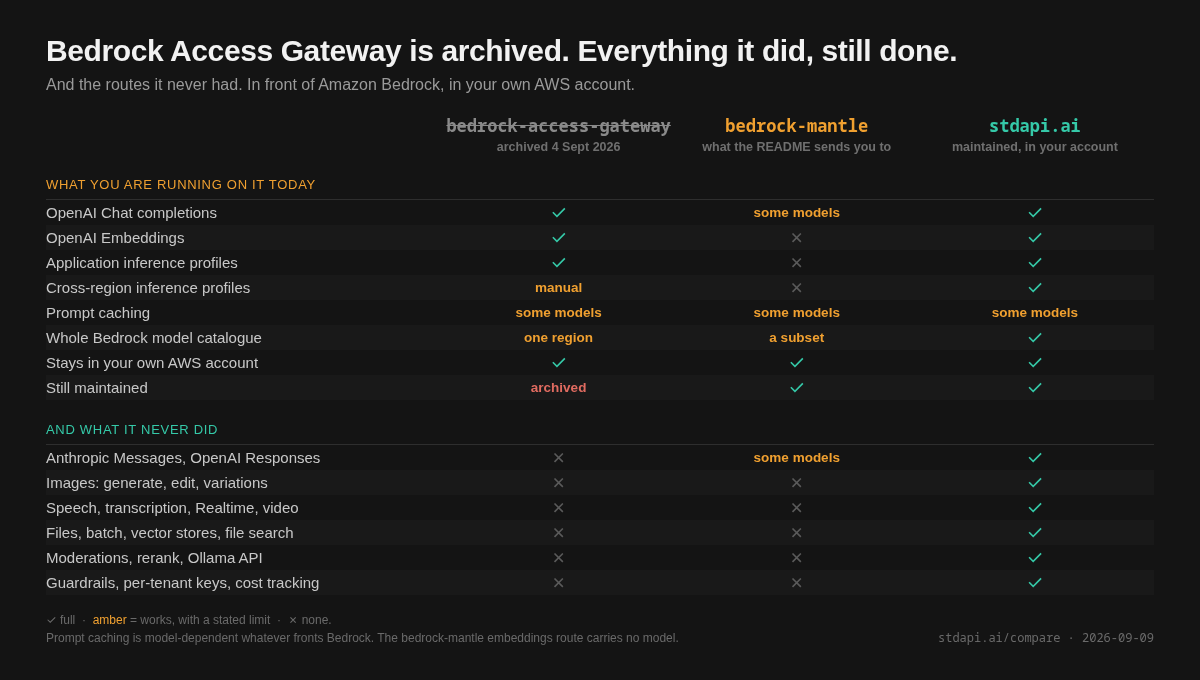
Working notes on running OpenAI-, Anthropic- and Cohere-compatible workloads on Amazon Bedrock: what the catalogue actually contains, what it costs, where it runs, and where the gateway options differ.

What if you could deploy a fully private ChatGPT alternative — on your own AWS infrastructure, with your own data sovereignty rules — in 30 minutes?

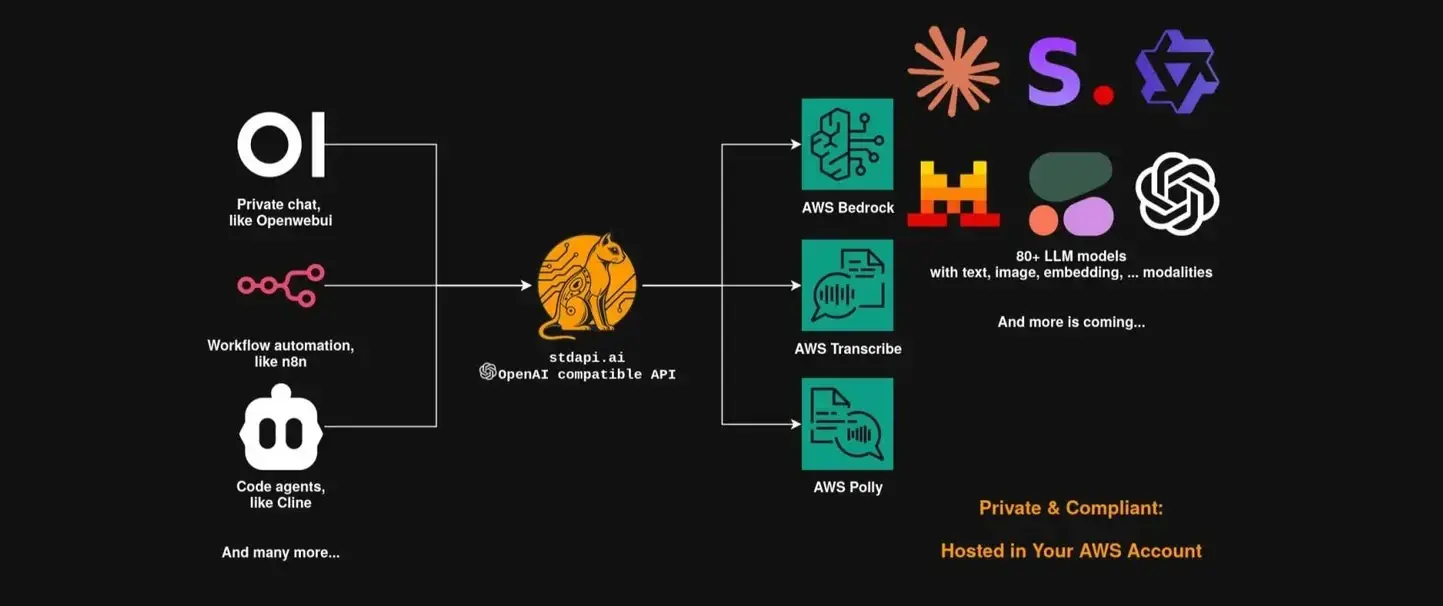
Use your existing OpenAI-compatible tools (OpenWebUI, n8n, Cline, Cursor) with AWS Bedrock's 100+ models and AWS AI services (Polly, Transcribe). Point the client at your gateway instead of the vendor's. Deploy to your AWS account with Terraform. No third party sits between your users and your models.
from openai import OpenAI
<!-- more -->
# Just change this line ↓
client = OpenAI(base_url="https://your-aws-api/v1", api_key="your-key")
# Everything else stays the same ↓
response = client.chat.completions.create(
model="anthropic.claude-sonnet-4-5-20250929-v1:0", # Claude 4.5 on Bedrock
messages=[{"role": "user", "content": "Hello from AWS!"}]
)
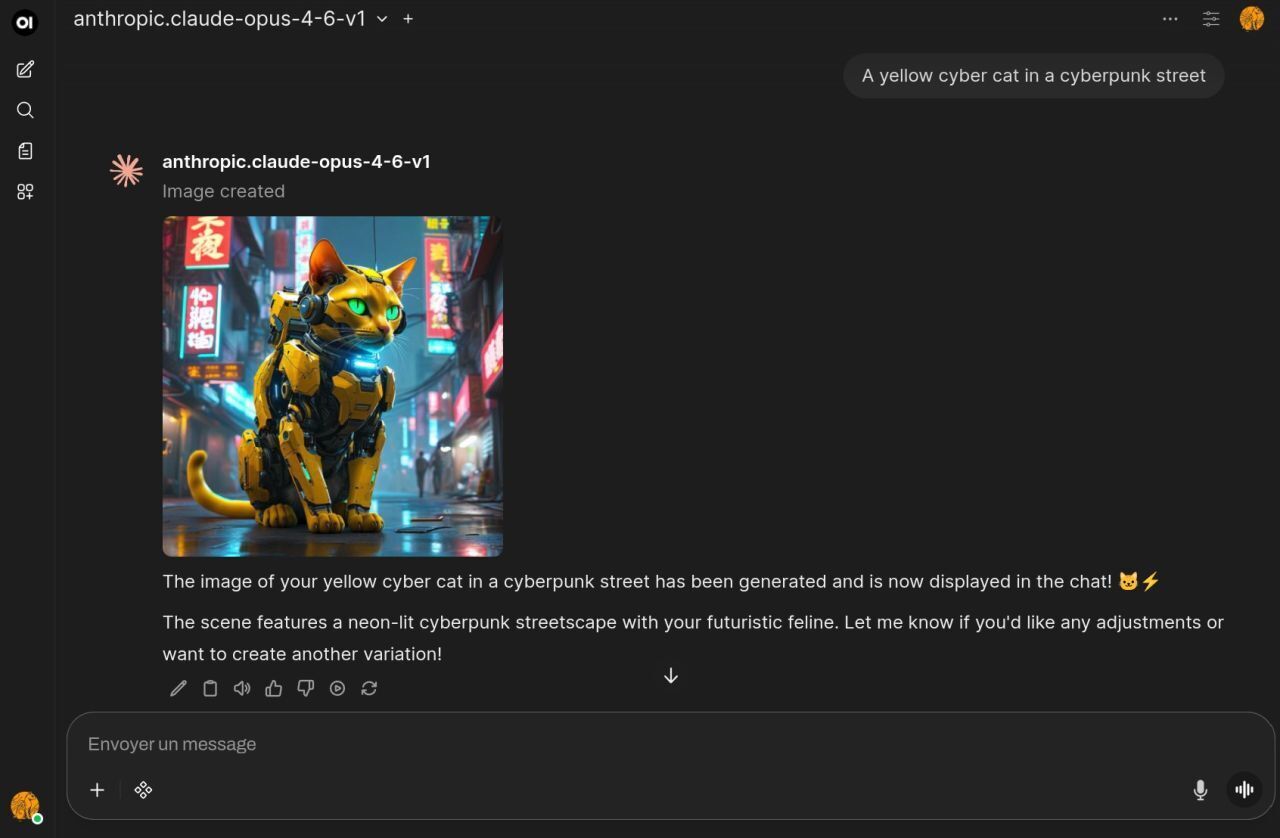
What this enables: - Use OpenWebUI, n8n, Cline, Cursor with AWS Bedrock and AWS AI services - Access Claude, Nova, Qwen, DeepSeek, Mistral, Cohere and 100+ more models - Text-to-speech (Polly), speech-to-text (Transcribe), image generation, embeddings - Inference runs on the AWS services you enable, in the regions you allow - Multi-region model access from a single endpoint
Most modern AI tools are built for OpenAI's API, but AWS Bedrock uses a completely different SDK. This forces you to choose between using familiar tools or switching to AWS for compliance/cost reasons and rewriting everything.
We ran into this while working with a customer who needed: - Data control: inference on the AWS services and regions they choose - Choice: Multiple models (Claude, Nova, Qwen, Mistral, DeepSeek, Stability AI, Cohere) - Multi-region access: Different Bedrock models available in different AWS regions - Standard tooling: OpenWebUI, n8n, IDE coding agents (Cline, Cursor) - Full AWS AI stack: Bedrock models plus Polly (TTS) and Transcribe (STT)
stdapi.ai is an API gateway that sits in your AWS account and translates OpenAI API calls to AWS services.
OpenAI API Compatibility
Your existing code works without modifications:
from openai import OpenAI
client = OpenAI(
base_url="https://your-deployment.example.com/v1", api_key="your-api-key"
)
# Chat completions
response = client.chat.completions.create(
model="amazon.nova-pro-v1:0",
messages=[{"role": "user", "content": "Explain AWS Lambda"}],
)
# Text-to-speech with Polly
response = client.audio.speech.create(
model="amazon.polly-neural", input="Welcome to the future of voice technology!"
)
# Speech-to-text with Transcribe
with open("meeting-recording.mp3", "rb") as audio_file:
transcription = client.audio.transcriptions.create(
model="amazon.transcribe", file=audio_file, response_format="json"
)
# Image generation with Bedrock
response = client.images.generate(
model="stability.stable-image-ultra-v1:0",
prompt="A serene mountain landscape at sunset",
)
# Embeddings with Bedrock
response = client.embeddings.create(
model="cohere.embed-v4", input="Semantic search transforms how we find information"
)
Multi-Region Access
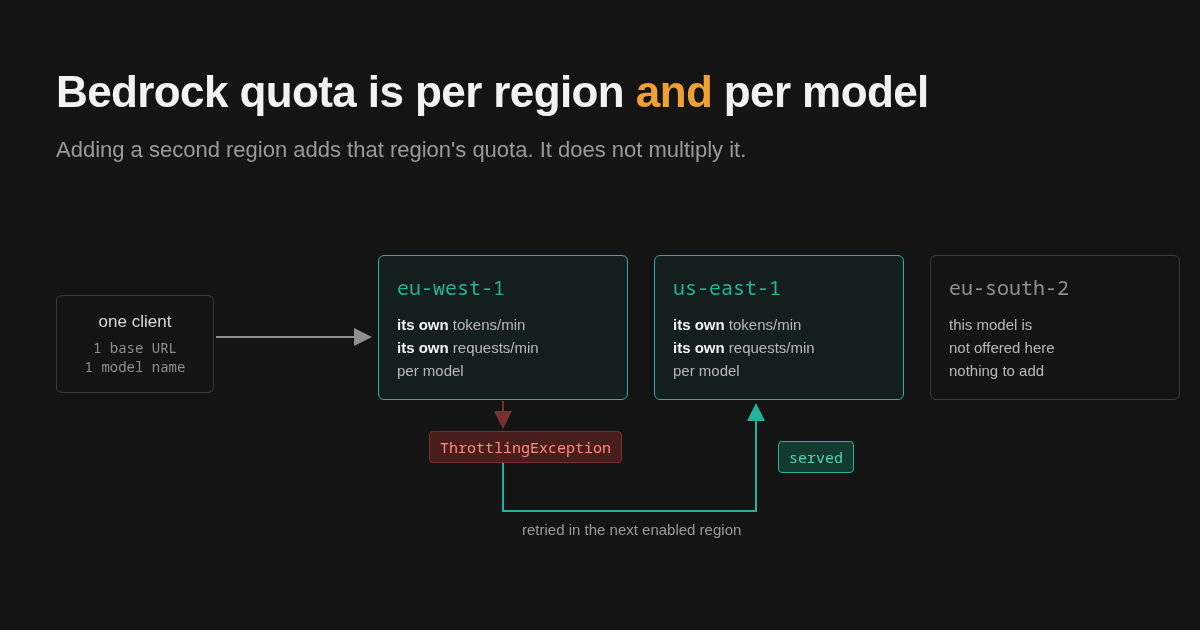
Access models across multiple AWS Bedrock regions from a single endpoint. Different models are available in different regions. You can configure which regions to include based on your requirements. AWS Bedrock inference profiles handle automatic routing when needed.
Multi-Modal Capabilities
Process text, images, videos, and documents together in a single request. Supports HTTP URLs, S3 URLs (for direct access to your data), and base64 data URIs. Perfect for vision tasks, document analysis, and RAG applications.
Deploy to your AWS account in 5-15 minutes using Terraform.
Sample configurations set up: - Application Load Balancer with ECS/Fargate - IAM roles with least-privilege access - CloudWatch logging - S3 storage - Optional: Custom domain with ACM certificate
Get started: Sample Terraform configurations
How It Works: 1. Converts OpenAI API format to Bedrock's format 2. Maps model IDs to appropriate AWS services and regions 3. Provides unified access to models across configured AWS regions 4. Converts Bedrock responses back to OpenAI format 5. Supports streaming via Server-Sent Events (SSE)
Security: - All traffic stays within your AWS account - IAM role-based access control - Optional API key authentication - VPC deployment supported - Integrates with AWS Bedrock guardrails
Performance: - Low latency translation layer - Streaming response support - Scales with ECS/Fargate auto-scaling
stdapi.ai is available as open source (AGPL-3.0) for experimentation and internal use.
For production deployments, we recommend the AWS Marketplace version, which includes: - Hardened container images - Regular security updates - Production support - 14-day free trial
The commercial license also removes AGPL obligations for proprietary applications.
🏢 Recommended: AWS Marketplace (14-day free trial, production-ready)
🚀 Open source: GitHub (AGPL-3.0 for experimentation)
📦 Sample deployments: Terraform configurations
📚 Documentation: Full guides and API reference
This translation layer approach solves the AWS Bedrock compatibility gap while keeping everything AWS-native.
Key benefits: - Zero code changes: Your OpenAI SDK code works as-is - AWS-native: Fully integrated with Bedrock, Polly, Transcribe - Multi-region: Access models across AWS regions from one endpoint - Production-ready: Terraform deployment, CloudWatch integration
We'd love to hear your feedback! Have you solved this problem differently? What challenges have you faced integrating Bedrock into your workflow?
We're planning detailed tutorials on:
Want a specific tutorial? Drop a comment or open an issue on GitHub!